

The rewritten version of the content is as follows:
– Glòria Sánchez – Europa Press
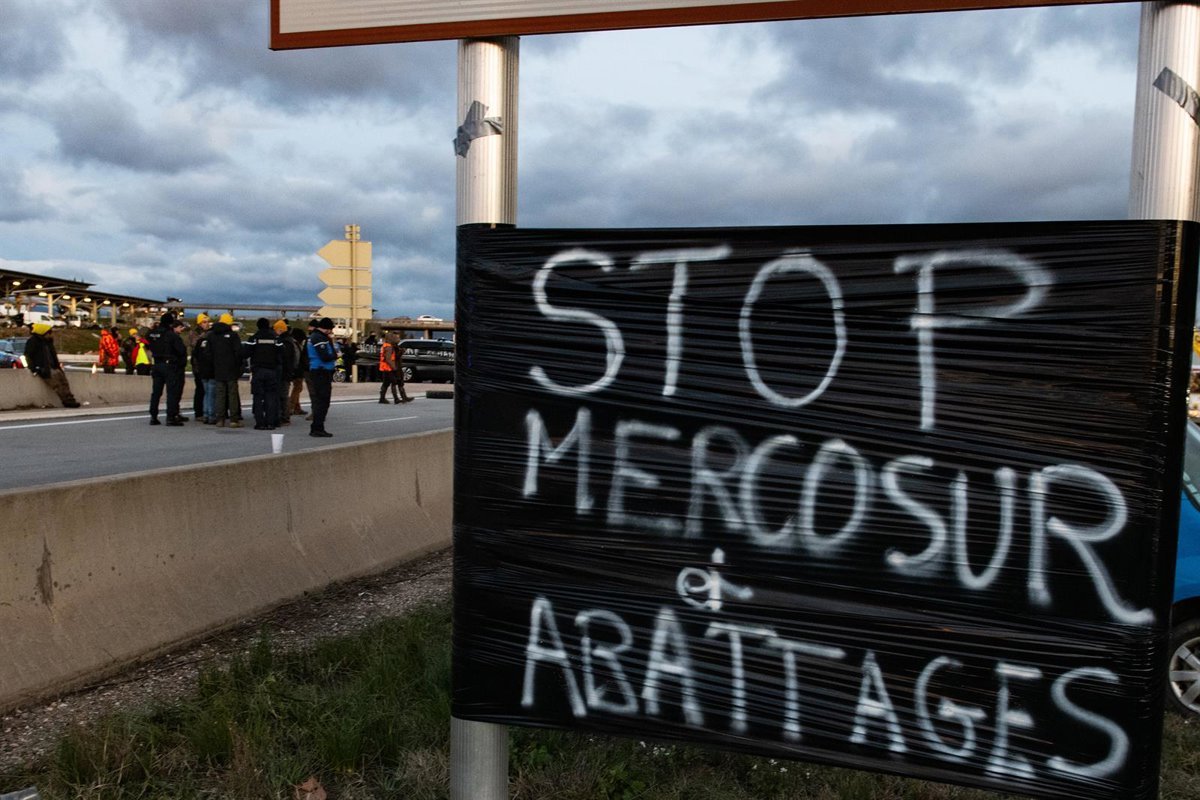
Catalan farmers, mobilized this Thursday and Friday at different points in the territory against the trade agreement between the European Union (EU) and Mercosur, fear the negative impact this pact will have on their businesses and criticize that the profits will not reach their pockets: «Only large investors will benefit».
Among the critical voices is that of Rafel Verdiell, a rice farmer with 100 hectares in the Delta de l’Ebre (Tarragona), who maintains in statements to Europa Press that the regulatory asymmetry between both trade blocs will promote unfair competition by allowing the entry of products that do not comply with the strict environmental regulations imposed in Europe.
«They are taking advantage of them because they are cheap labor and ruining European farmers. This agreement will affect us very negatively, we cannot compete against those countries,» warns the farmer.
ACCIÓ REPORT
The agreement between the European Union and Mercosur, approved this Friday, would affect very differently various key sectors of the Catalan economy, and while exports from the automotive sector, for example, could increase with the reduction of tariffs, the agri-food sector, such as rice farming, could be harmed.
According to the report ‘Economic Impacts of the EU-Mercosur Agreement in Catalonia’, prepared by Acció – the agency for business competitiveness of the Government – at the end of 2024, Catalonia is the second Spanish autonomous community that imports the most from Mercosur, with 20.8% of the total, only behind Andalusia.
Catalan imports from Mercosur have exponentially increased in the last two decades, with Catalan purchases from the region growing by 58% more between 2020 and 2023, concentrated especially in agricultural products such as beans, fruits, oils, rice, or meat, accounting for 70% of the total.
The agreement between both regions, which involves a significant reduction in tariffs on trade between countries on both sides of the ocean, will increase competition and «may harm agricultural products that Catalonia also exports to the EU, such as rice or wine,» warns the report.
LARGE DISTRIBUTORS
The person in charge of rice at Unió de Pagesos, Josep Antoni Vidal, who also owns rice farms in the Delta de l’Ebre, explains to Europa Press that the real purpose of this agreement is nothing but to generate benefits for large distributors.
He cites the ‘Everything But Arms’ initiative promoted by the EU, under which all imports from member countries from less developed countries in the world are duty-free, except for arms, to help them out of poverty.
«One of the countries that benefited was Myanmar, one of Spain’s rice exporters, but these people are still as poor today. These agreements do not benefit the local population, but the large distributors,» asserts Vidal.
PORK
According to Acció’s report, the entry of products from Mercosur, especially beef, poultry, and soybean oil, could act as a «substitute» for Catalan pork and olive oil, which could negatively affect exports of these products from Catalonia.
Rossend Saltiveri, a pig farmer who owns a pig farm in Ivars d’Urgell (Lleida), tells Europa Press that the disparities in technical and sanitary requirements between the EU and Mercosur will be another obstacle to the marketing of pork, hindered by the African swine fever (ASF) crisis.
«If they want to introduce production in Europe, it should be under the same conditions that we have, which are much more demanding in terms of animal welfare or the prohibition of certain phytosanitary and products,» he demands.
Although Saltiveri acknowledges that the European pork sector does not face as immediate a threat as beef, poultry, or rice, he focuses on Brazil’s export potential: «It is a major producer of pork and will be even more so. It is true that it has a greater need to cover domestic consumption, but its production costs and regulatory requirements are lower.»
INSTITUTIONAL RESPONSE
Despite the protests of the farmers, which began early on Thursday in Catalonia but have also taken place in different points of France, Germany, or Greece, the group of Member States gave the green light on Friday to the signing of the agreement thanks to the qualified majority.
The European ‘Yes’ has not been absolute, however, and while France, Hungary, Poland, Austria, and Ireland voted against, Belgium abstained, while Spain emerged during the negotiations as one of the main supporters of the agreement.
The Minister of Agriculture, Fisheries, and Food, Luis Planas, defended last Thursday that «it is a serious mistake to see Mercosur as a threat, because it is a great opportunity, but also for the agri-food sector.»
ORDEIG CALLS FOR «CLEAR RULES»
The Minister of Agriculture, Livestock, Fisheries, and Food, Òscar Ordeig, said this Friday before meeting with representatives of the agrarian mobilizations that the Catalan primary sector should not worry to be competitive with Mercosur countries «if done with clear rules and equal opportunities.»
He emphasized that products that do not follow the same controls and limitations as European products cannot be imported, while calling for a negotiated solution with farmers to lift road closures or access to the Port of Tarragona to avoid «very large economic damage.»